
AI & Classical Guidance: A Hybrid Future
Explore why AI won't replace classical guidance laws but will enhance them. Discover the benefits of a hybrid architecture that combines proven methods with adaptive AI for robust, certifiable, and safe systems in challenging environments.
4/22/20261 min read
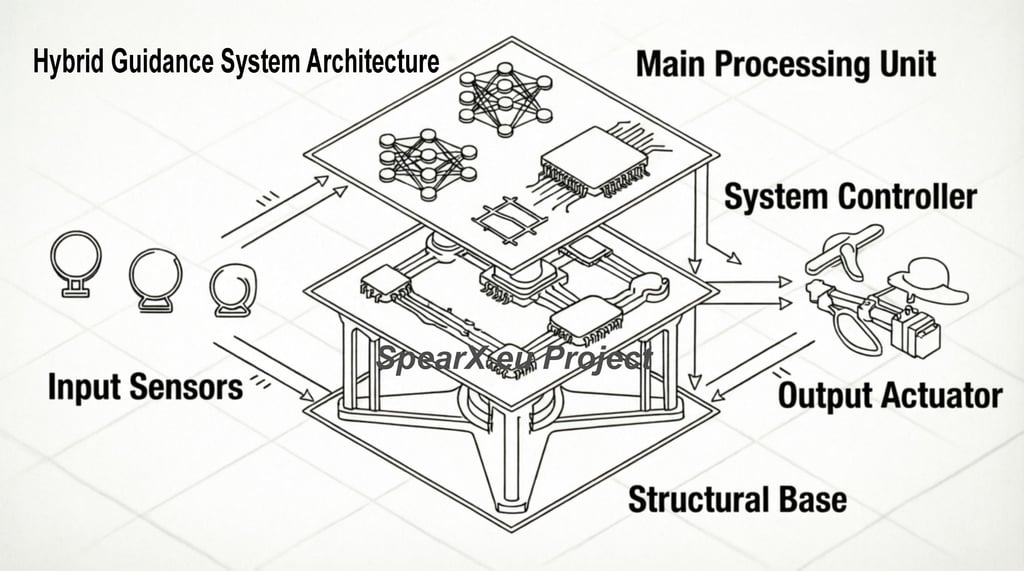

In the C-UAS space, we keep hearing: "AI will replace traditional guidance."
We disagree!. Here is why?
Classical guidance laws (like Proportional Navigation) are mathematically proven.
They work. They are predictable. They are certifiable.
But in my opinion they have limits:
→ Assume predictable target motion
→ Struggle with erratic maneuvers (like FPV drones)
→ Need clean sensor data (rarely available in EW)
AI/ML excels where classical methods struggle:
→ Pattern recognition in noisy data
→ Adaptive prediction against non-linear targets
→ Sensor fusion under uncertainty
But AI has its own problems:
→ Hard to certify for safety-critical systems
→ Unpredictable failure modes
→ Requires massive compute and data
The answer is not "AI vs. classical." It is "AI + classical".
Our approach at SpearX:
✓ Mid-course: Classical PN (stable, cheap, predictable)
✓ Terminal phase: AI for adaptive tracking (handles chaos)
✓ Safety layer: Runtime assurance with fallback to PN
This hybrid architecture gives us:
→ Certifiability (classical backbone)
→ Adaptability (AI for edge cases)
→ Safety (guaranteed fallback)
The future is not replacement. It is augmentation.
Pure AI is powerful but hard to certify. Pure classical is safe but limited against erratic targets. Hybrid balances performance vs. safety.
The hard part is the handoff logic:
• Smooth transition without control jumps
• Fail-safe fallback if AI inference lags
• Explainability for military certification
Key insight from SpearX:
AI does not replace the guidance law. It improves the perception layer feeding it.
Classical theory + modern implementation = robust systems.
Related : GEOCOM Co. LLC www.geocomco.eu DeepTechRnD www.deeptechrnd.eu SpearXAgro www.spearxagro.eu
Contacts
SpearX ↑ Strike with Precision
+359 877 620 210
D-U-N-S® 525540791


© 2025 - 2026. All rights reserved. SpearX Projects. Geocom Co. LLC



SpearX is an EU-Ukrainian company located in a strategic areas for R&D in UAV