
15 Pixels: A Design Challenge in Small Target Detection
Discover why 15 pixels isn't a low data issue but a design constraint in small target detection. Learn how motion detection, optics, and algorithms can enhance object recognition and improve tracki...
5/22/20261 min read
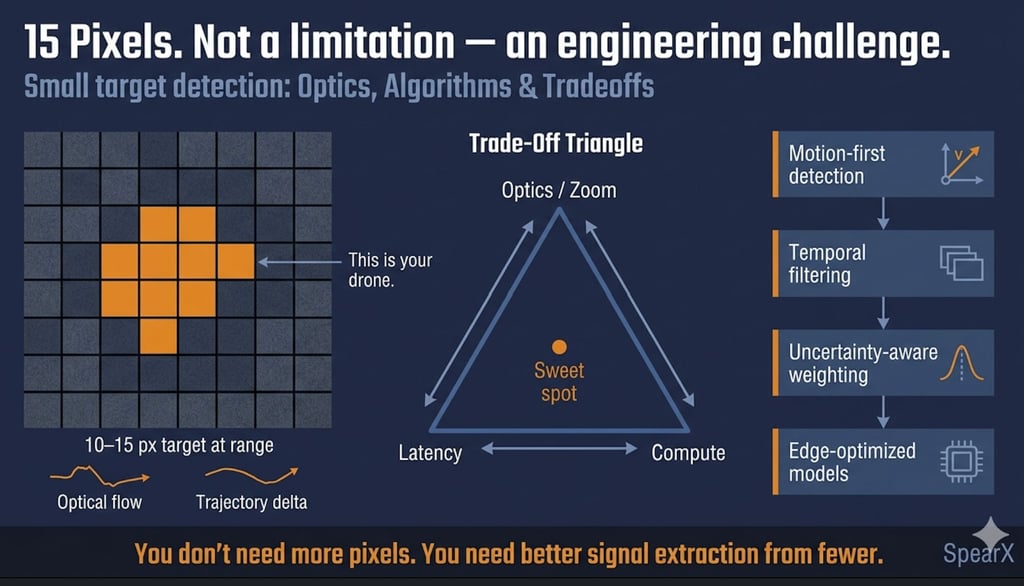
Small target detection: Optics, Algorithms & Tradeoffs.
In object detection & recognition tasks, often we hear: "The target is too small. We need higher resolution."
At SpearX, we see it differently. 15 pixels isn't a data shortage. It's a design constraint that forces better engineering.
§ The Reality of Small Targets
At range, a drone isn't a detailed object. It's a moving cluster of 10-15 pixels. Traditional CV models fail here. Why? They rely on shape, texture, and context - all of which vanish at distance.
§ Motion Over Appearance
When pixels are scarce, motion becomes the signal. Optical flow, trajectory consistency, and behavioral patterns matter more than static features. A 15-pixel target moving against background flow is detectable long before it's "recognizable."
§ Trade-Off Triangle
Optics ↔ Latency ↔ Compute
Higher zoom = narrower FOV + slower response. More pixels = heavier models + edge delay. We optimize for the sweet spot: sufficient angular resolution + real-time inference + robust tracking under vibration.
How we handle it at SpearX
§ Motion-first detection: prioritize kinematic signatures over visual detail.
§ Temporal filtering: track across frames, not single shots - errors must not propagate.
§ Uncertainty-aware weighting: if vision confidence drops, we lean on trajectory prediction or RF cues.
§ Edge-optimized models: quantized, pruned, but mathematically sound.
§ Bounded adaptation: like the "Avoidance Limit" concept, we define confidence envelopes - the system knows when it's uncertain and adjusts behavior accordingly
You don't need more pixels! You need better signal extraction from fewer pixels!
Small targets force us to stop chasing resolution and start engineering for motion, context & certainty.
The same principle applies to fleet coordination: precision in time and space matters more than raw data volume. A 15-pixel target tracked with temporal consistency beats a 100-pixel blur with no trajectory.
Related : GEOCOM Co. LLC www.geocomco.eu DeepTechRnD www.deeptechrnd.eu SpearXAgro www.spearxagro.eu
Contacts
SpearX ↑ Strike with Precision
+359 877 620 210
D-U-N-S® 525540791


© 2025 - 2026. All rights reserved. SpearX Projects. Geocom Co. LLC




SpearX is an EU-Ukrainian company located in a strategic areas for R&D in UAV