
Understanding 2-Pixel Errors in Autonomous Guidance
Explore how a 2-pixel error can lead to a 50-meter miss in autonomous guidance systems. Discover the intricate relationship between vision algorithms and vehicle dynamics, focusing on algorithm prediction and target tracking. Learn how engineers connect vision and control for precise navigation.
5/5/20262 min read
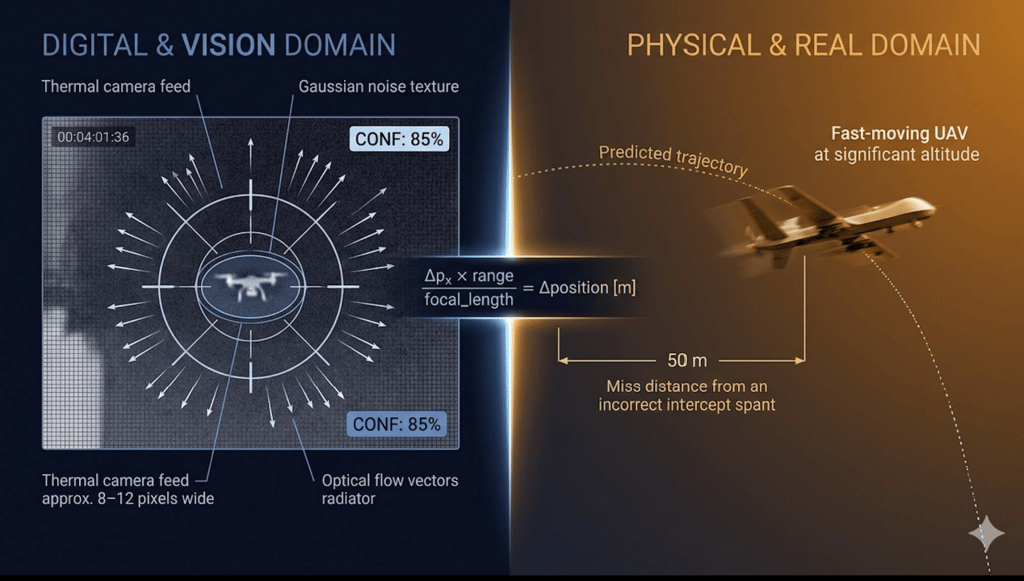
Vision-based guidance is not just "camera sees → system turns".
It is a careful dance between how the algorithm "sees" & how the machine physically moves.
When a camera replaces radar in the control loop, computer vision stops being a "black box" - it becomes part of the flight physics.
How does "camera → steering command" really work?
- The eyes: from image to space
A camera is not just video for a human. For the algorithm, each frame is a set of coordinates. But lenses distort the image, vibrations shift the horizon, and targets can be just 5-15 pixels wide. Engineers must teach the system to understand real-world geometry - filtering noise so each pixel matches a real direction in space.
- Time matters: speed over resolution
The chain "capture → process → decide → act" takes time. While the algorithm processes one frame, a fast target has already moved. Miss 2–3 frames at high speed, and the system is chasing the past. Good algorithms don't just detect - they predict where the target will be when the command actually executes.
- Scale and optical flow
A 1-pixel shift means centimeters up close, but meters at long range. Classic guidance uses a simple idea: if the target stays in the same spot in the image, paths will intersect. But cameras measure angles, while controls adjust linear motion. The system must adapt its response - even without knowing exact distance.
- Filtering noise, trusting wisely
Camera data is always noisy. How do we tell a real target maneuver from camera shake or detection error? Smart filters smooth the signal. Too sensitive → the system jerks. Too slow → it misses the turn. Modern systems also estimate confidence: if vision is uncertain (e.g., due to glare), the controller eases its response instead of overreacting.
How do engineers connect vision and control?
1️. Remove self-motion - A moving platform makes the whole scene shift. Algorithms subtract the platform's own rotation to isolate the target's true motion.
2️. Predict, don't just react - Instead of reacting to the current pixel position, advanced systems forecast where the target will be when actuators respond. This needs tight time sync between vision and control modules.
3️. Share uncertainty - The vision module doesn't just send "(x, y)". It adds: "I'm 85% sure". If confidence drops, the guidance law automatically becomes more cautious.
Key insight:
In autonomous guidance, there is no such thing as "just an image". A tiny pixel error, multiplied by speed and system delay, becomes a real-world miss. The modern approach is co-design: vision algorithms are trained with vehicle dynamics in mind & control laws are built to handle vision-specific errors. Honest algorithms tell the system not only "where the target is", but also "how sure I am".
Related : GEOCOM Co. LLC www.geocomco.eu DeepTechRnD www.deeptechrnd.eu SpearXAgro www.spearxagro.eu
Contacts
SpearX ↑ Strike with Precision
+359 877 620 210
D-U-N-S® 525540791


© 2025 - 2026. All rights reserved. SpearX Projects. Geocom Co. LLC



SpearX is an EU-Ukrainian company located in a strategic areas for R&D in UAV