
The Truth About Thermal Cameras' Limitations
Discover the physics behind LWIR thermal cameras and why they can't see everything, day or night. Learn how advanced engineering techniques like kinematic prediction and dynamic sensor fusion can o...
7/20/20262 min read
Hardware sets the ceiling, but software sets the floor. Here is the 4-layer engineering approach we use at SpearX to defeat this physical limitation:
1️⃣ Kinematic Prediction
We use a modified ByteTrack + Kalman Filter. The state equation predicts the drone's position for 30 to 60 frames purely on velocity and kinematics. This bridges the gap when the YOLO detector outputs zero confidence during the crossover dip, preventing the track from collapsing.
2️⃣ Optical Flow & ReID
When Kalman drifts due to sudden maneuvers, we trigger Dense Optical Flow (RAFT algorithm) to track pixel movement within the Region of Interest (ROI). If the track completely drops, a lightweight Re-Identification (ReID) neural network re-acquires the target the millisecond its thermal signature recovers.
3️⃣ Dynamic Sensor Fusion in Real-Time
We fuse video data across different spectral bands. The weight of the thermal channel drops dynamically via a sigmoid function when ΔT approaches the sensor’s NETD threshold. The system automatically shifts the processing load to another spectrum (like SWIR), which relies on reflected light rather than heat, remaining completely unaffected by thermal equilibrium.
4️⃣ Micro-Contrast Enhancement
This is where cooled sensors truly shine. Their ultra-low noise floor allows us to apply aggressive CLAHE (Contrast Limited Adaptive Histogram Equalization) without amplifying noise. This pulls out micro-signatures invisible to uncooled cameras: aerodynamic friction on leading edges (+0.3°C) or hot stator motors, even right at the edge of crossover.
The Result?
Track loss during crossover dropped from 34% to just 6%, and MOTA (Multi-Object Tracking Accuracy) jumped to 89%. Cooled sensors give us a wider safety margin, but only smart software closes the remaining physical gap.
In CUAS, the winner isn't the team with the most expensive sensor. It’s the team that respects physics and codes a solid Plan B.
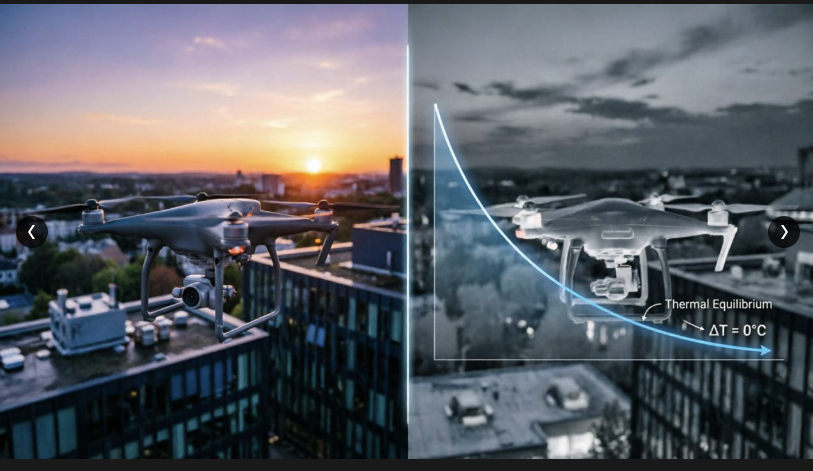
We constantly fight a massive industry myth: "LWIR thermal cameras see everything, day or night." This is a marketing fairy tale. Every LWIR sensor, whether cooled or uncooled, has a fundamental physical blind spot called THERMAL CROSSOVER.
Let’s talk physics.
Vendors love to push cooled InSb or MCT sensors with NETD <20 mK. And yes, they are vastly superior to uncooled microbolometers. They detect microscopic ΔT and deliver crisp imagery. But physics is absolute: when the target’s true temperature equals the background temperature, ΔT = 0. No sensor, regardless of its price tag or cooling system, can detect zero contrast. Cooled sensors merely delay the crossover window; they do not eliminate it.
Related : GEOCOM Co. LLC www.geocomco.eu DeepTechRnD www.deeptechrnd.eu SpearXAgro www.spearxagro.eu
Contacts
SpearX ↑ Strike with Precision
+359 877 620 210
D-U-N-S® 525540791


© 2025 - 2026. All rights reserved. SpearX Projects. Geocom Co. LLC



SpearX is an EU-Ukrainian company located in a strategic areas for R&D in UAV