
The Physics of Interception Systems Explained
Discover how advanced math and physics are vital in developing interception systems for drone technology. Explore the balance between autonomy and human-in-the-loop decision-making, energy management, and real-time target tracking for effective aerial defense.
3/16/20262 min read
"Just fly & hit" - that is what beginners think.
At SpearX, we see interception as a complex mix of control theory, flight physics & ethics.
We build systems that work against different threats - from small scout drones to larger kamikaze-type UAVs. Each target type is a unique math challenge.
Today we share our engineering approach:
1. Target physics & dual prediction
The target does not fly in a straight line. It moves, changes direction, uses terrain.
🔹 Task: Calculate target trajectory in real-time with high reliability.
🔹 Solution: Dual calculation system. Both the interceptor (on-board) AND the ground station run parallel physics models. They predict target movement using speed, acceleration, and behavior patterns. This double-check increases accuracy - if one system has issues, the other continues tracking.
2. Physics and Energy of the Interceptor
Our drone has hard limits: thrust, inertia, aerodynamics, and available energy.
🔹 Task: The algorithm cannot ask for the impossible. A sharp maneuver needs high power. If the battery is low, voltage can drop, and motors lose power at the worst moment.
🔹 Solution: Energy management is part of the guidance system. The algorithm "knows" the current charge. It picks a trajectory that saves energy and keeps a buffer for mission end and return.
3. Human-in-the-Loop
Technology is a tool. Responsibility stays with humans.
🔹 Our principle: Even with high autonomy (tracking, guidance, meeting point calculation), the final decision stays with the operator.
🔹 Why it matters: This is not only about ethics and rules. It is about quality. Human + AI make better decisions than each one alone.
4. Testing: Custom Simulator
You cannot test everything in real flights - it is expensive and not always safe.
🔹 Solution: We built our own custom simulator for various aerial targets. It models different threat types, weather conditions, R/EW scenarios, and interception paths. This lets us test thousands of situations before real flights. Faster iteration, better results.
5. Reaction Time (Latency)
In interception, milliseconds = meters of miss.
🔹 Task: Reduce delay between "seen" and "corrected".
🔹 Solution: Edge Computing. Data processing on-board, not in the cloud. Optimized decision pipeline.
Engineering takeaway
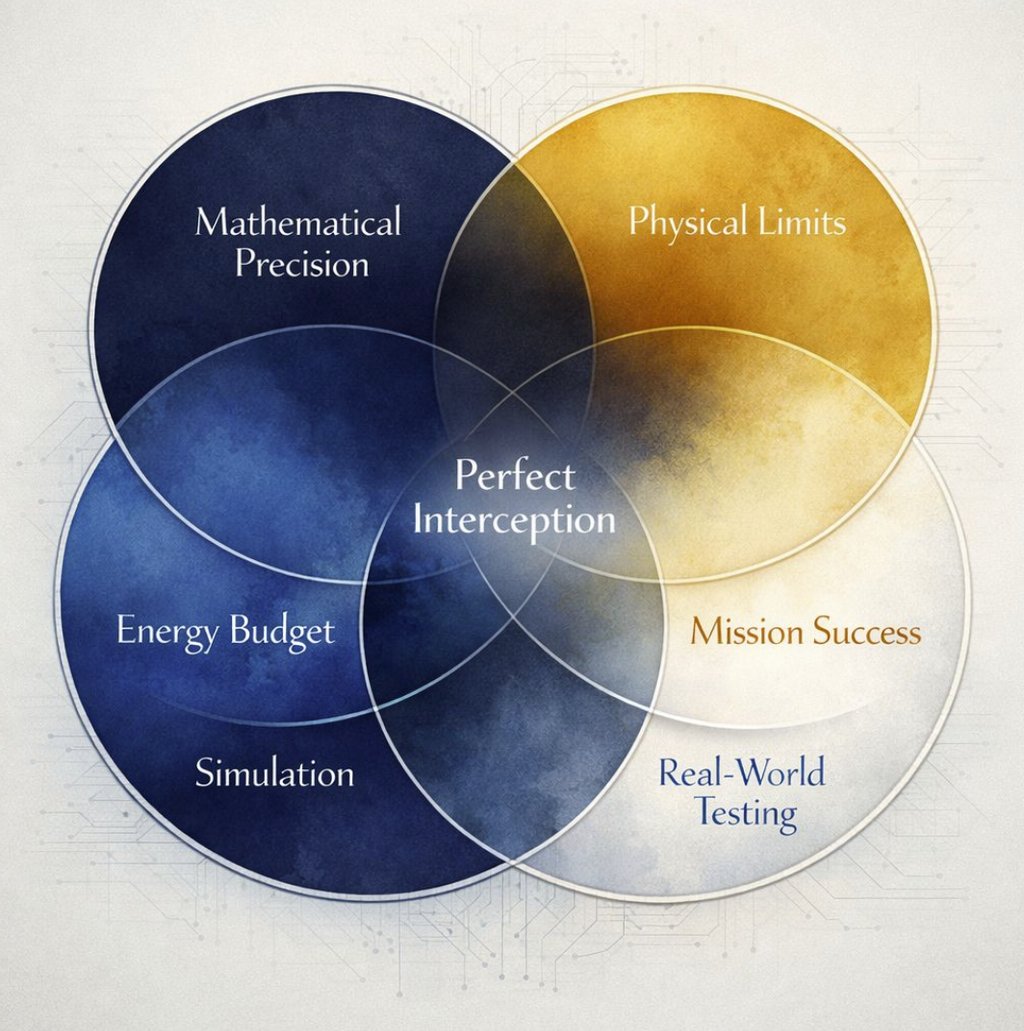
Building an interception system is not about "going fast". It is about balance between:
- Math precision and physical limits
- Energy budget and mission success
- Autonomy and human control
- Simulation and real-world testing
Related : GEOCOM Co. LLC www.geocomco.eu DeepTechRnD www.deeptechrnd.eu SpearXAgro www.spearxagro.eu
Contacts
SpearX ↑ Strike with Precision
+359 877 620 210
D-U-N-S® 525540791


© 2025 - 2026. All rights reserved. SpearX Projects. Geocom Co. LLC



SpearX is an EU-Ukrainian company located in a strategic areas for R&D in UAV