
Interceptor Drones: Mastering Targeting with Edge AI
3/27/20262 min read
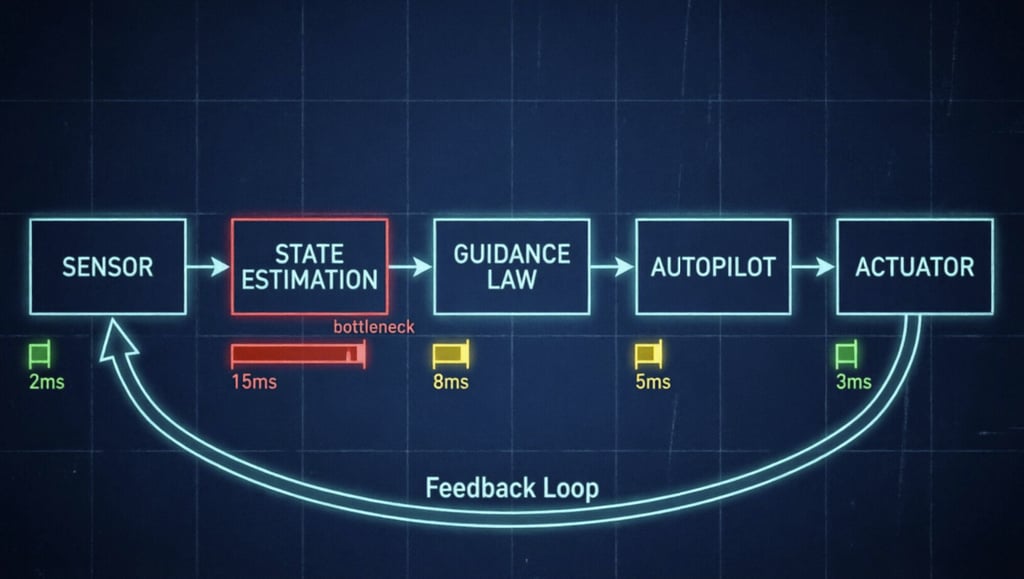
In one of the interception scenarios, a head-on encounter, it is not enough to simply send an interceptor towards an enemy UAV.
It seems straightforward: you see the target, you send the drone, and that's it.
But the probability of a miss is very high. The reason is physics. And it matters.
"Just fly there" doesn't work for 3 reasons:
1. Speed and direction matter The target drone flies at 150 km/h. Your interceptor flies at 200 km/h. Closing speed = 350 km/h. You have less than 1 second to react. If you aim at where the target is now, you miss. You must aim at where it will be. Simple math. Hard to do fast. When the interceptor and target have different trajectories, things get much more interesting, but that's a topic for a separate post.
2. Every millisecond counts Camera sees → Computer processes → AI decides → Drone turns. If this cycle takes 200ms and the target moves, you miss by meters. Cloud computing cannot work here. You need Edge AI. The decision must happen on the drone, right now.
3. The real world is chaos Sensors make mistakes. Wind pushes. The target changes direction. The system must be resilient. It cannot rely on one perfect path. It must check and correct course hundreds of times per second.
How we solve this at SPEARX We don't just make faster drones.
We build smarter systems.
Intelligent navigation math calculations.
Prediction models on the drone's flight controller.
Architecture where one sensor failure does not break the mission.
Key insight: The drone doesn't win. The system wins.
The drone alone is just a tool.
The real advantage is in the ecosystem: → Sensors that see the target → Algorithms that decide faster than a human → Communication that works under electronic warfare → Edge AI that processes data on board → Integration with C2 system → C-UAS tactics and strategy → And only then >>> the drone as the final tool
You can build the fastest interceptor in the world. But without detection, targeting, and coordination, it's just an expensive toy.
At SpearX, we don't just build drones. We build systems where every part makes the other stronger.
Defense engineering is not about hardware. It is about math and architecture that work in the chaos of real life.
0.5 seconds can be the difference between success and failure. Our job is to make this time as short as possible.
Related : GEOCOM Co. LLC www.geocomco.eu DeepTechRnD www.deeptechrnd.eu SpearXAgro www.spearxagro.eu
Contacts
SpearX ↑ Strike with Precision
+359 877 620 210
D-U-N-S® 525540791


© 2025 - 2026. All rights reserved. SpearX Projects. Geocom Co. LLC



SpearX is an EU-Ukrainian company located in a strategic areas for R&D in UAV