
C-UAS Testing: Simulation & HIL Explained
Discover how to effectively test C-UAS systems without real drones using simulation, hardware-in-the-loop, and digital twins. Learn about the three-level testing pyramid that ensures safety, cost-effectiveness, and efficiency in drone testing.
5/18/20261 min read
Hard truth: You cannot test C-UAS only with real drones.
Too expensive. Too slow. Too dangerous. Too hard to repeat.
So, how do you verify before field tests?
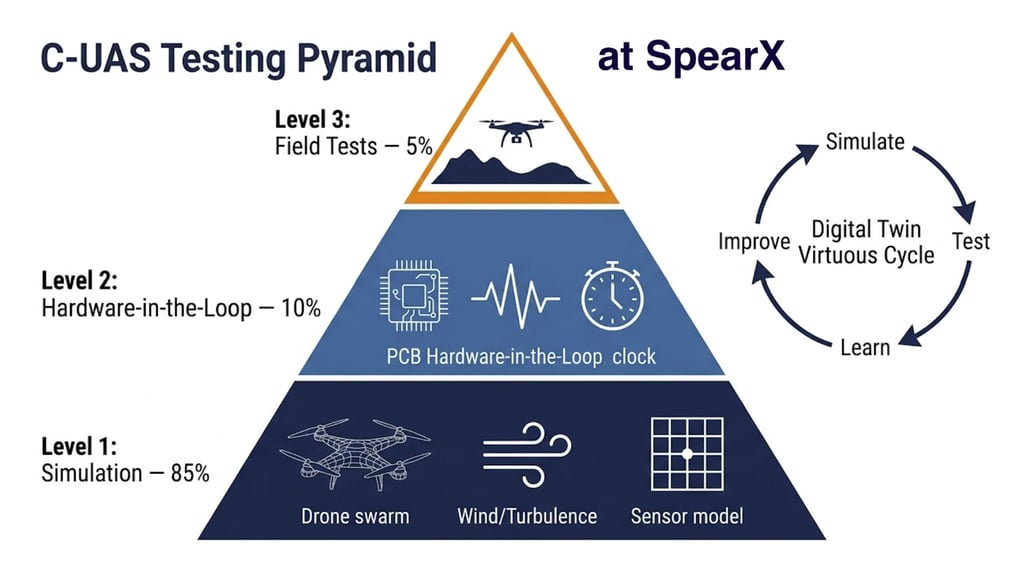
At SpearX, we use a three-level testing pyramid.
Level 1: Simulation 85%
Why: Infinite scenarios, zero risk. Repeatable. Edge cases on demand.
We simulate:
- Realistic physics: wind, turbulence, sensor noise, delays
- Multi-drone scenarios: swarms, coordinated attacks
- Sensor models: EO/IR with distortion, RF with multipath, acoustic noise
Tools: Gazebo, AirSim, custom engines. Digital twins of test sites.
Key: Domain randomization - every run has different parameters. Prevents overfitting.
Level 2: Hardware-in-the-Loop 10%
Why: Real hardware has quirks: timing jitter, sensor drift, power spikes.
What is HIL: Real flight controller + algorithms talk to simulator. Nothing moves, but everything tests.
We test:
- Real-time performance under load
- Integration bugs (driver crashes, packet loss)
- Edge cases: GPS spoofing, wind gusts, sensor failure
Setup: Real hardware + simulated sensors + real-time simulator + logging.
Level 3: Field Tests 5%
Why: Eventually, touch grass. But 99% of bugs are already found.
We test:
- Sim-to-real gap: where predictions mismatch reality
- Real-world factors: wind, RF interference, lighting
- Human factors: operator workload, interface clarity
Method: Start small → tethered flights → simple scenarios → gradually increase complexity.
Metrics: Detection accuracy, tracking stability, interception precision, latency, false positives.
Digital Twin Advantage
At SpearX - we maintain digital twins of every vehicle, sensor & test site.
After each field test, real data improves the simulator. Next simulation is more realistic.
Virtuous cycle: Simulate → Test → Learn → Improve → Repeat
Every layer catches different bugs. Skip one - find them in production.
At SpearX, 90% of testing happens in simulation. That's how we move fast without breaking things.
Related : GEOCOM Co. LLC www.geocomco.eu DeepTechRnD www.deeptechrnd.eu SpearXAgro www.spearxagro.eu
Contacts
SpearX ↑ Strike with Precision
+359 877 620 210
D-U-N-S® 525540791


© 2025 - 2026. All rights reserved. SpearX Projects. Geocom Co. LLC



SpearX is an EU-Ukrainian company located in a strategic areas for R&D in UAV