
Protect Your Drone from GNSS Attacks
Learn how to safeguard your drone against GNSS attacks like GPS jamming and spoofing. Discover four layers of protection, from hardware solutions to advanced signal monitoring and future-proofing strategies. Ensure mission success and drone safety even when GNSS is compromised.
3/14/20261 min read
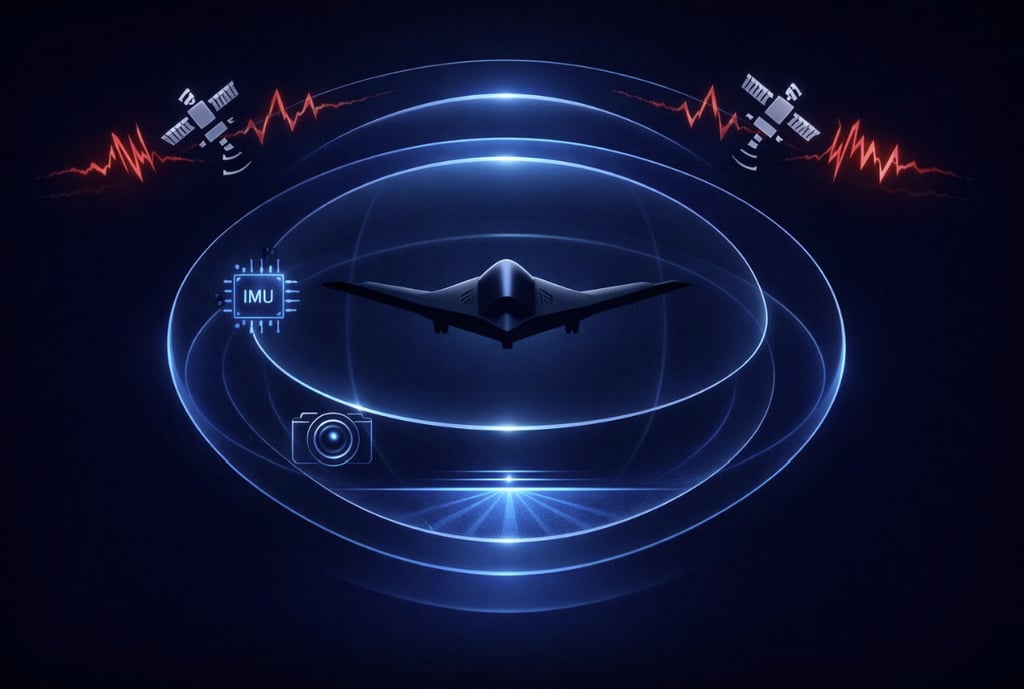
GPS is everywhere. But it's also fragile.
For UAV, two main threats exist:
Jamming - signal blocked by noise. Drone loses position and may fail to complete mission.
Spoofing - signal faked by attacker. Drone receives false coordinates and can be silently redirected.
Jamming is loud and easy to detect. Spoofing is quiet and much harder to catch.
Here's how to defend 4 layers:
Layer 1: Hardware Protection
• CRPA antennas - phased array that blocks interference directionally (military grade)
• Multi-frequency + multi-constellation - GPS+Galileo+GLONASS on L1/L2/L5 bands
• RF filters - cut out-of-band noise at the antenna input
+ Makes jamming harder.
- Doesn't stop sophisticated spoofing alone.
Layer 2: Signal Monitoring
• C/N₀ checks - sudden drop = jamming; unusually high value = possible spoofing
• SQM (Signal Quality Monitoring)
• Doppler analysis - ground-based spoofers have wrong frequency profile vs real satellites
+ Fast anomaly detection.
- Needs access to receiver raw data.
Layer 3: System Architecture
• GNSS + IMU fusion - if GNSS drifts beyond threshold, system switches to IMU
• External sensors - VIO, LiDAR, UWB work as backup
• Consistency checks - flag impossible jumps in position or speed as potential attacks
Most effective layer. Works even when GNSS is fully compromised.
Layer 4: Cryptography & Authentication (Future)
• OSNMA (Galileo) - digital signatures on navigation messages, verified by receiver
• Chimera (GPS L1C) - upcoming authentication system for GPS signal
Strong protection against spoofing when deployed.
- Not widely available yet.
Engineering Recommendations:
For Commercial Drones (budget limited):
→ Multi-constellation + multi-freq GNSS receiver
→ GNSS + IMU fusion (mandatory)
→ C/N₀ monitoring + behavioral consistency checks
→ RF filters on antenna
For Defense / Critical Missions:
→ Everything above, plus:
→ CRPA antenna
→ External sensors: VIO, LiDAR, magnetometer
→ OSNMA/Chimera support in future
→ Hardware time sync (PPS) for precise anomaly detection
For Future-Proof Systems:
→ Design architecture with modular sensor integration
→ Keep firmware update path open for new authentication protocols
→ Log all GNSS anomalies for post-mission analysis and ML training
Key Insight:
There's no silver bullet. GNSS protection is a layered architecture, where each level compensates for the weaknesses of others.
Jamming is loud. Spoofing is quiet. But both scenarios should end the same way: your drone completes the mission or returns safely - even without GNSS.
Related : GEOCOM Co. LLC www.geocomco.eu DeepTechRnD www.deeptechrnd.eu SpearXAgro www.spearxagro.eu
Contacts
SpearX ↑ Strike with Precision
+359 877 620 210
D-U-N-S® 525540791


© 2025 - 2026. All rights reserved. SpearX Projects. Geocom Co. LLC



SpearX is an EU-Ukrainian company located in a strategic areas for R&D in UAV