
Drone Defense: Why Decision-Making Trumps Speed
The counter-drone market is set to reach EUR 47 billion by 2030. While many focus on interceptor speed, the real challenge lies in the time taken for decision-making. Discover how sensor integratio...
2/11/20263 min read
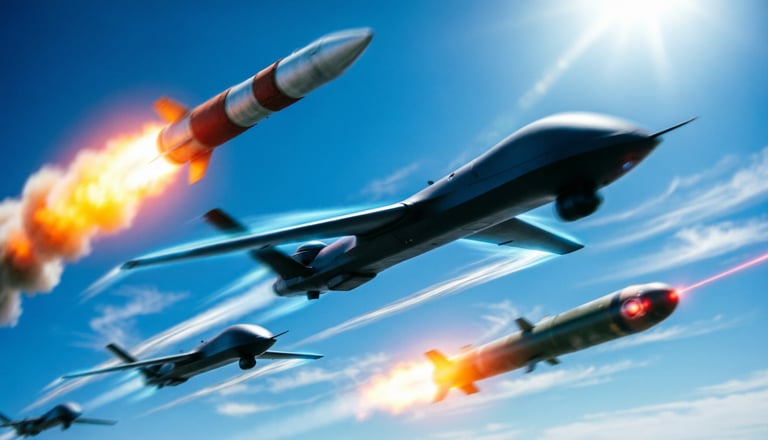
Everyone talks about "the fastest interceptor!" "The longest-range radar!"
But speed alone won't win.
The market for counter-drone systems (C-UAS) will reach $47 billion by 2030. Many companies focus on interceptor speed or radar range. But the real challenge is different.
The real challenge is the time between detecting a drone and the operator's decision to act.
Why time matters more than speed?
Modern threat drones can fly at 200–250 km/h. At this speed, a drone travels 70 meters in one second. In 3 seconds - 210 meters. In 5 seconds - 350 meters. This could be the distance from the outer fence to the most important building on site.
If your system detects a drone 500 meters away, but the operator needs 6 seconds to decide - the drone travels 420 meters. It might be too close already. Even a very fast interceptor won't arrive in time.
Interceptor speed is important. But if your decision system is slow - speed won't save you.
What slows down the decision process?
1. Sensors work separately
Most systems have radar, cameras, and radio detectors. But they don't work together. Radar shows "Object in sector 142°". The operator must turn the camera manually. The camera shows a quadcopter. The radio detector is silent - the drone flies on GPS. The operator connects all this information alone. It takes 7–12 seconds. Too long.
2. Too many false alarms
Many AI systems trigger for birds, plastic bags, or reflections. The operator gets tired of constant "alarms" and starts ignoring them. When a real threat appears - the reaction is too late. Good AI should not just "see an object". It should understand context: Is the drone flying toward something important? Does it behave like a threat?
3. Hard for operators to decide quickly
EU law and NATO standards require: the human must make the final decision. This is correct. But if the interface is not well designed - the operator needs 6–9 seconds to verify. A good interface reduces this to 2–3 seconds.
Our approach at iSpearX
We don't focus only on speed. Our interceptor can briefly reach 320 km/h - technically possible. But we focus on something else: faster decision-making.
How we do it:
- Data from thermal camera (LWIR), visual camera (RGB) and radio sensors merge directly on the drone in 12 milliseconds. The operator sees one clear picture - not separate signals.
- Our AI analyzes in 45 milliseconds not just "This is a drone". It checks: Is it flying toward a critical object? Does it behave aggressively? Does its signal match known threats?
- The ground station interface shows all important information at once. The operator needs ≤3 seconds to confirm the decision.
- The human always makes the final decision. Two operators must press two separate buttons at the same time within 3 seconds. This is safe - and fast.
- After confirmation, activation happens in 0.9 seconds thanks to a pre-calculated trajectory.
Result: 4.2 seconds from detection to intercept readiness. 0.9 seconds from confirmation to activation.
The future: different threats need different solutions
Today's main threats are drones up to 250 km/h. We have a solution for them now.
But threats are evolving. New challenges could include:
- Very fast drones (over 300 km/h)
- Swarms of dozens of drones flying together
- Drones that don't emit radio signals
These threats need different solutions. Not just "faster", but "smarter". Different detection logic. Different sensors. Different decision architecture.
We are already working on next-generation technology. For now - in stealth mode (no public announcements). Because in the $47 billion market, advantage will go not to those who talk loudest about speed. But to those who design the whole system carefully - from sensor to human decision.
Conclusion
Winners won't be those with the fastest drone. Winners will be those with the shortest, most reliable chain: sensor → analysis → human decision → action.
This is not a speed race. This is a race for smart systems.
Related : GEOCOM Co. LLC www.geocomco.eu DeepTechRnD www.deeptechrnd.eu SpearXAgro www.spearxagro.eu
Contacts
SpearX ↑ Strike with Precision
+359 877 620 210
D-U-N-S® 525540791


© 2025 - 2026. All rights reserved. SpearX Projects. Geocom Co. LLC



SpearX is an EU-Ukrainian company located in a strategic areas for R&D in UAV