
C-UAS Standards: Interoperability as a Force Multiplier
Explore the importance of C-UAS standards and interoperability in defense systems. Learn how open APIs, NATO-grade data links, and standardized protocols can eliminate integration headaches and enhance operational efficiency in critical defense infrastructure.
4/14/20261 min read
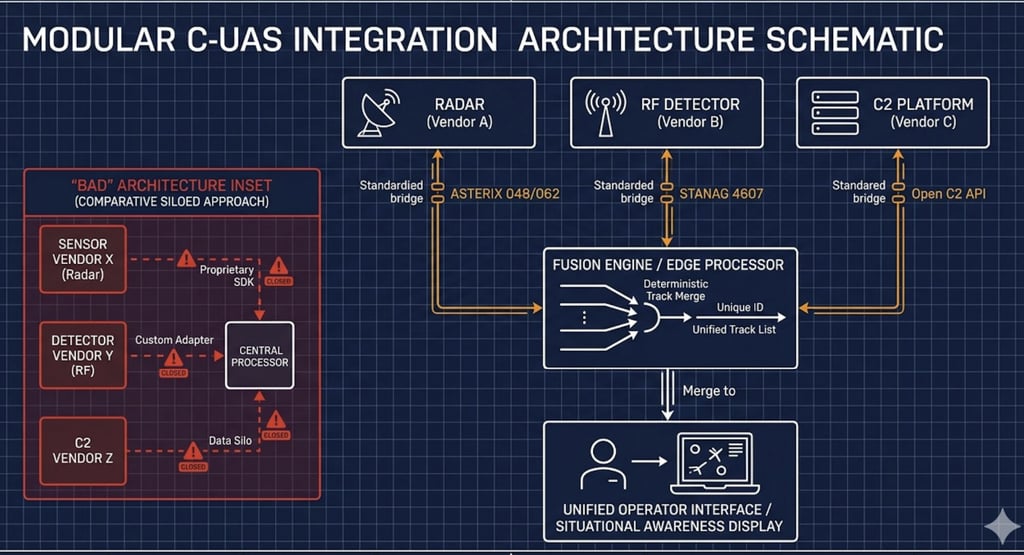
You buy a radar from Vendor A, an RF detector from Vendor B, a C2 platform from Vendor C.
Demos look flawless.
Integration reveals the reality: proprietary protocols, custom data formats, closed APIs. Six months later, you’re maintaining three siloed tools that struggle to share track data.
This isn’t just an engineering headache. It’s a systemic bottleneck.
Standards aren’t bureaucracy. They’re interoperability enablers.
• ASTERIX Cat.048/062: Deterministic binary track formatting. Enables low-latency multi-sensor fusion and clean C2 integration.
• STANAG 4607/4703: NATO-grade data links for UAV/C-UAS. Critical for allied operations and joint exercises.
• ASTM F3411 / U-space: Bridges civilian Remote ID with defense detection. Essential for airspace deconfliction.
• Open C2 APIs: Versioned, documented, schema-validated interfaces. Not a custom adapter delivered after PO signing.
The real cost of ignoring standards:
x Integration debt: 2-6 months per sensor to normalize tracks & align timestamps
x Data silos: Tracks from one system can’t fuse with another
x Upgrade paralysis: Swapping one module means rewriting the middleware stack
x Compounding TCO: Proprietary SDKs & support contracts add up over time
What should an ideal C-UAS system look like?
It’s not defined by the longest-range radar or the fastest interceptor. It’s defined by architecture: open, modular, and protocol-agnostic. A system where new sensors integrate via standardized APIs, tracks fuse deterministically at the edge, and software updates don’t break hardware dependencies. It’s a platform built on interoperability, not vendor locks.
The SpearX approach:
We’re building exactly that. Not with overnight hype, but with disciplined, step-by-step engineering. We prioritize open APIs, strict schema validation, lab-based conformance testing, and a fusion engine designed to evolve alongside the threat landscape.
We move deliberately, because in critical defense infrastructure, resilience and adaptability always beat short-term speed.
The Bigger Picture:
C-UAS isn’t a single-vendor hardware challenge. It’s an ecosystem puzzle. No one company covers every threat vector, environment, or regulation. Standards + open interfaces are the only path to scalable, future-proof defense.
Related : GEOCOM Co. LLC www.geocomco.eu DeepTechRnD www.deeptechrnd.eu SpearXAgro www.spearxagro.eu
Contacts
SpearX ↑ Strike with Precision
+359 877 620 210
D-U-N-S® 525540791


© 2025 - 2026. All rights reserved. SpearX Projects. Geocom Co. LLC



SpearX is an EU-Ukrainian company located in a strategic areas for R&D in UAV