
AI Defense Myths Debunked: Reality Check
Discover the truth behind common AI defense myths. Learn how AI acts as a force multiplier, the importance of signal fidelity over data volume, and why pre-trained models require fine-tuning for effective use in real-world scenarios.
4/13/20261 min read
AI in C-UAS: 3 Myths That Kill Real Deployments
Everyone’s selling “AI-powered C-UAS.”
Few CUAS systems that survive urban multipath or EW saturation.
Why? Procurement and architecture are built on three dangerous myths.
Myth 1: “AI will autonomously neutralize threats.”
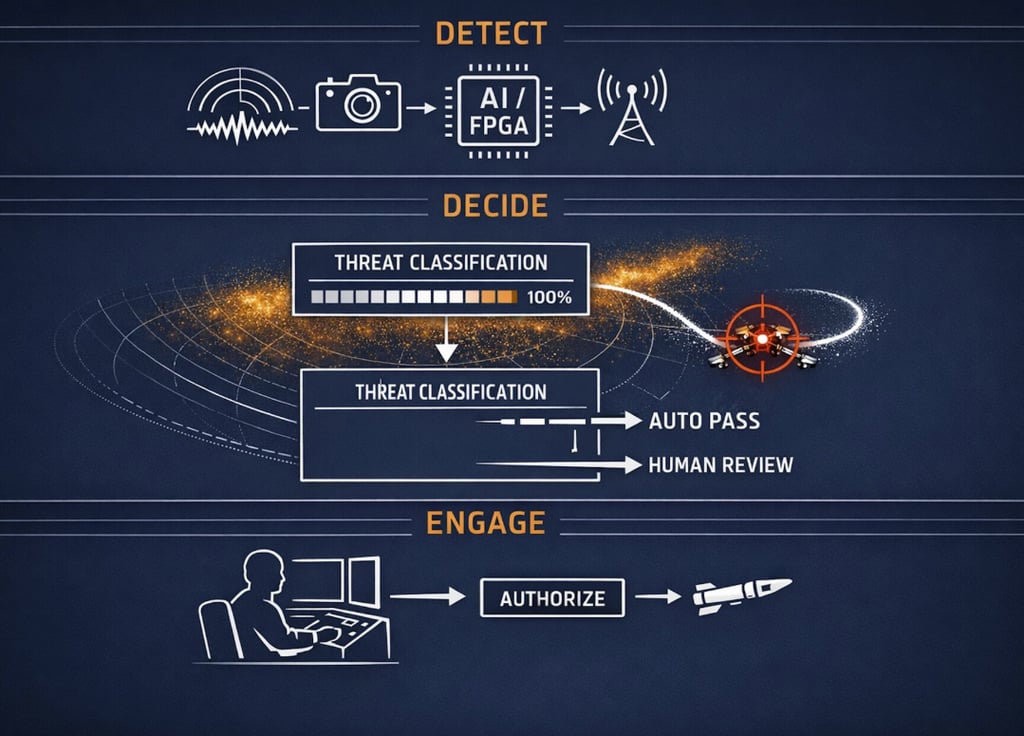
Reality: In defense, AI is a force multiplier, not a trigger puller. Urban clutter, partial jamming, and asymmetric FPV tactics push false positive rates beyond acceptable thresholds for kinetic/legal action. AI handles detection & preliminary classification (<50ms). Escalation, engagement, and legal accountability remain strictly human-in-the-loop. Remove HITL, and you’re not building defense-you’re engineering a liability.
Myth 2: “More data = better models.”
Reality: 10,000 hours of empty sky won’t teach a network to distinguish a modified FPV from a peregrine falcon. C-UAS lives on signal fidelity, not volume. Synthetic data accelerates pre-training, but without physical validation on real RCS profiles, micro-Doppler propeller signatures, and thermal cross-sections, models hallucinate in production. Curated, adversarially robust datasets > petabytes of noise. Always.
Myth 3: “Pre-trained models work out-of-the-box.”
Reality: COCO/ImageNet weights fail against 0.001 m² targets in industrial RF/optical noise. C-UAS demands domain-specific fine-tuning: sensor physics (FMCW, event-based, SDR), environmental degradation, threat kinematics, and strict edge constraints (INT8 quantization, <15W power, sub-100ms pipeline latency). Transfer learning is a starting point. Production-ready C-UAS AI is engineered, not downloaded.
Architectural truth:
Treat AI as a transparent, auditable module in your sensor fusion stack. Demand XAI/SHAP explanations, validate against real-world ROC curves (not Kaggle accuracy), and bake human-AI handoff protocols into v1.0.
Related : GEOCOM Co. LLC www.geocomco.eu DeepTechRnD www.deeptechrnd.eu SpearXAgro www.spearxagro.eu
Contacts
SpearX ↑ Strike with Precision
+359 877 620 210
D-U-N-S® 525540791


© 2025 - 2026. All rights reserved. SpearX Projects. Geocom Co. LLC



SpearX is an EU-Ukrainian company located in a strategic areas for R&D in UAV